
Finding Floyd County Crime News
Start with Coosa Valley News's Arrest Reports category. This outlet posts sheriff-formatted daily PDFs on a regular schedule, which makes it a solid index when someone no longer shows up on the current-inmate list. WRGA runs frequent arrest briefs alongside its other Floyd County reporting. Those short pieces draw from jail records, warrants, and agency releases, but editors choose what runs. The station covers stories, not the full booking feed.
Northwest Georgia News's Rome local section works as a traditional paper, and search engines have surfaced sheriff arrest-report PDFs hosted on its pages. Verify anything you find there live, since an old report can linger after the fact has changed. For bigger or stranger cases, the FOX 5 Atlanta Floyd County tag aggregates regional coverage. Television picks the dramatic story, not the routine booking.
Each source serves a different purpose. An agency release explains an operation. A newspaper preserves a daily report. TV focuses on major events. For custody status and case outcomes, the county roster and court docket still beat them all. Coosa Valley's plain category view is also easy on the eyes, since it lists reports without forcing you through a photo gallery.

The index helps identify the date and source format. It does not make the publisher the custodian of a Floyd County booking record.
Floyd County News Outlets and Photos
Local crime coverage uses photos, but on no fixed schedule. Some sheriff reports arrive as PDFs with the booking picture attached. Other briefs skip images or run a generic story shot. Countywide aggregator pages can post dozens of pictures at once. Be careful with those. They are unofficial, and they often leave outdated charges on display long after the fact. Official sources come first in the list.
| Outlet | Coverage | Photos? | Where |
|---|---|---|---|
| Floyd County Sheriff's Office | Agency notices, wanted cards, custody links, and public-safety information. | Official wanted page has photos; a current booking-photo feed was not confirmed. | Sheriff's Office |
| Coosa Valley News | Near-daily Floyd arrest-report index and broader county news. | Often links sheriff-formatted daily PDFs with photos. | Arrest Reports |
| WRGA / Local News Now | Frequent narrative arrest briefs plus civic and crime reporting. | Story-dependent, not a complete photo feed. | Floyd County |
| Northwest Georgia News | Rome and regional local reporting. | Story-dependent; live cadence needs confirmation. | Rome local news |
| FOX 5 Atlanta | Selected regional Floyd County stories. | Event-driven. | Floyd County tag |
| RecentlyBooked | Unofficial rolling county archive with a claimed last-30-days view. | Yes, but freshness and identity require checking. | Floyd section |
| Georgia Gazette | Unofficial county section and separate Floyd context page. | Yes, with names, dates, charges, and some narratives. | Floyd section |
| Mugshots.com and Arrests.org | Unofficial archive or county-local pages. | Photos may appear; access and update claims vary. | Mugshots.com and Arrests.org |
No verified Floyd-local Busted Newspaper or Mugshots.zone section exists. Don't guess at a URL. Also watch the geography. A story may name Rome, Cave Spring, or another town, yet its arrest roundup actually pulls from several agencies at once.
Floyd Coosa Reports and WRGA Briefs
Coosa Valley News keeps old reports alive. Long after someone walks out of the jail, its pages can still carry a sheriff-style summary. These often include the full name, physical descriptors, the date and hour of the arrest, where it happened, and which officer made it. Bond or release details, the charges booked, and a photo may appear too. One caution applies. The category date on the article reflects publication, not necessarily the jail event. And a missing attachment says nothing about whether arrests happened that day.
WRGA works differently. Its near-daily "Arrest Reports for" posts turn jail records, warrants, and agency releases into brief narratives. Editors choose what makes the cut. A brief might skip a record, squeeze several fields into one line, or say nothing about what happened next. So treat it as a pointer. It gives you the agency and the date. Official sources should carry the weight after that.
Keeping these formats straight avoids two common mistakes. A daily PDF is not a live roster. A news brief is not a full daily count. Who is in custody right now is the sheriff's question. A released booking, or a photo that never appeared online, belongs in a focused records request. Later outcomes live with the court.
How Floyd Booking Photos Reach News
How does a Floyd booking photo end up in a news story? A few paths exist. An agency may release an existing record. A publisher may obtain one through public records law. Or a sheriff-formatted report may simply get republished. Georgia's open-records framework opens the door to existing records, with exemptions and redactions allowed. It does not force a sheriff to keep a permanent online gallery or build a custom feed for anyone who asks.
Source tracing matters here. The older daily report format bears a sheriff heading, yet the archive hosting it sits on a non-government, non-current site. Coosa Valley News frequently links to that report. Meanwhile, an official current-inmate page may show fewer fields and no confirmed photo. So one source can display the same arrest with a picture while another drops it entirely after release.
Copies spread further. Once a photo gets copied onto an unofficial page, it can drift loose from any correction or update. A responsible description names the image's origin, gives the report date, and points back to the office that produced it. It does not rank people, enlarge faces, or treat a picture as proof of anything beyond the booking itself.
Record boundary: A publisher can report a booking while the sheriff still holds the intake file. Ask the agency for the record and the court for the outcome.
From a Floyd Story to the Record
A news story is a solid first clue when it hands you a name, a date, an agency, or a warrant reference. It grows stronger when each source down the line answers its own question:
- Preserve the story date. A publication date may not be the arrest or booking date.
- Check current custody. Search the Floyd County roster and booking treatment when the person may still be held.
- Request the intake file. Use the county records portal for a released booking, booking sheet, photograph, or release entry.
- Match the identity. Compare age, date, agency, charge identifier, and case number rather than relying on name alone.
- Follow the court. Search the appropriate Floyd docket for amendments, dismissal, plea, acquittal, conviction, or another disposition.
- Correct stale copies. Use the publisher's documented free correction or removal route when a qualifying result exists, then refresh a search cache after the source changes.
A news story is a starting point. It is not a case file. What you read first is the arrest report and the booking photo, both tied to a single day. The real outcome comes later, from the court. Check the record before you draw any conclusion from a headline.
Custody status matters too. It splits in several directions. Someone released after booking may have already dropped off the current roster. A sentenced prisoner will show up in the Georgia Department of Corrections system instead. Federal and immigration cases each need their own locator. No news page can sort through all of that for you.
Unofficial Floyd Mugshot Archives
Several third-party sites host Floyd County booking photos. None of them are official custodians. RecentlyBooked, Georgia Gazette, Mugshots.com, and Arrests.org all publish county-local pages with photos, charge wording, and booking dates. Treat them warily. Entries can sit stale, run incomplete, or match the wrong person entirely. RecentlyBooked offers a rolling 30-day view with search by name, date, or charge, refreshed several times daily, and its published policy allows free review on listed grounds. Mugshots.com keeps a deep Floyd archive and a maintenance process covering qualifying records. Georgia Gazette runs a genuine Floyd section plus a removal request page describing the Georgia statutory route. Arrests.org has a Floyd section as well, though its update cadence and sourcing stay unclear.
These archives are leads. For custody, intake, and case outcomes, go straight to the sheriff, the county records custodian, and the court, in that order. You can see the layout for yourself through the RecentlyBooked Floyd section and the Georgia Gazette Floyd section.
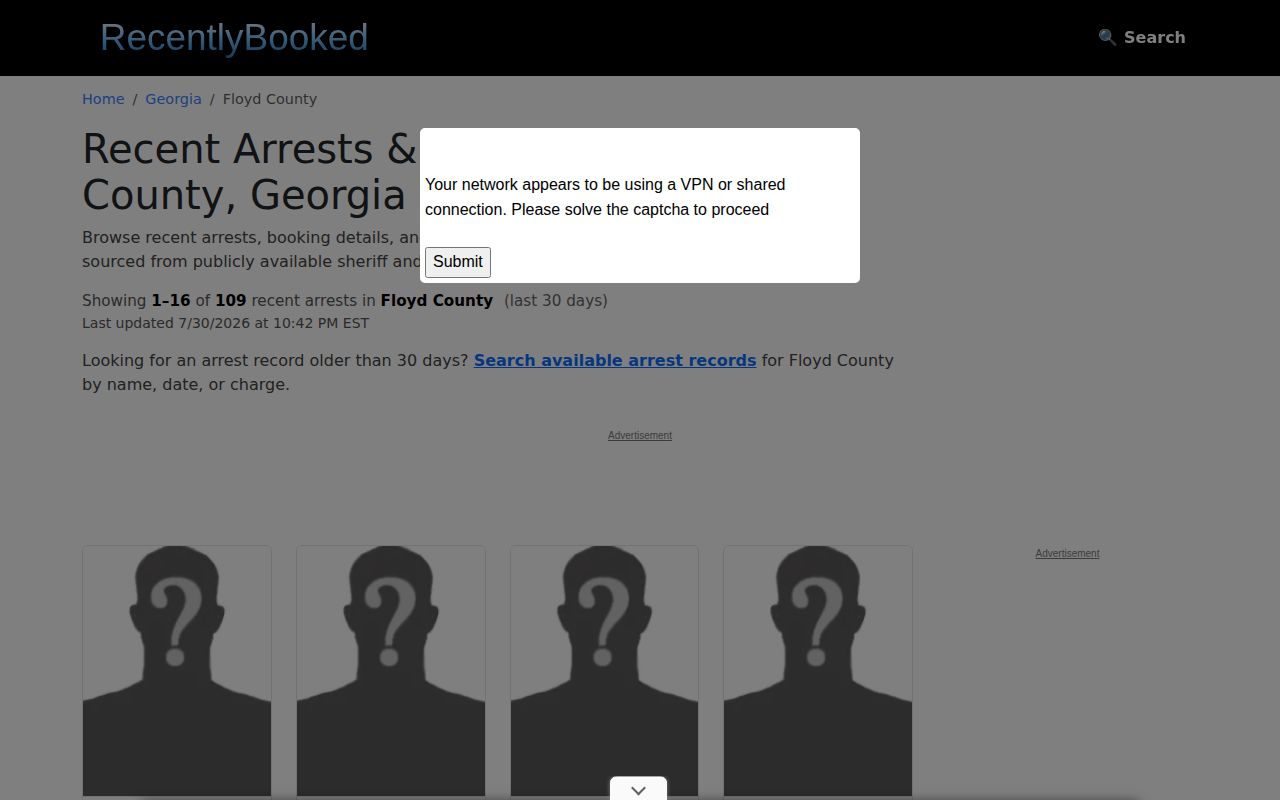
A rolling archive can help you pin down a date. Just confirm its freshness and sourcing on your own before relying on it.
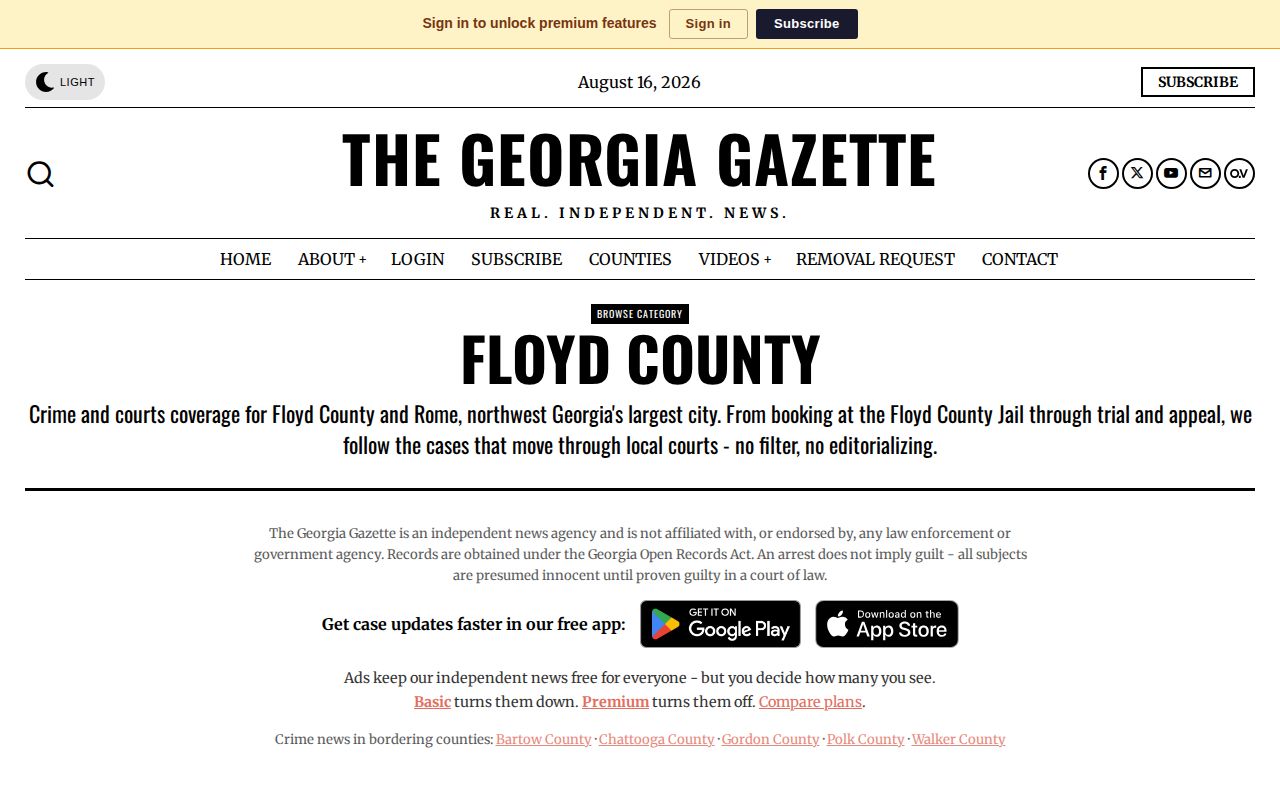
Third-party images are secondary material. Tie them back to the court and agency record first.
Floyd County City News Coverage
Rome holds most of the county's incorporated-city population and runs its own police department. Cave Spring has municipal police too. Neither city publishes a daily person-level arrest feed or mugshot roster, so a city name in a headline tells you little about which agency made the arrest. County reports often pool Rome Police, the sheriff, Floyd County Police, Georgia State Patrol, and other agencies together.
The paper trails differ as well. A Rome arrest produces a police report at the city and a booking record at the county jail, and Cave Spring works the same way. The municipal report carries the narrative. The jail holds the shared booking record and photograph. The Rome Busted Mugshots and Cave Spring city resources walk through those local handoffs. Cave Spring also separates E-911 calls from arrests, since calls for service are not booking totals, charges, or unique people.